
These guidelines and assessment criteria are issued by Chile’s Environmental Assessment Service (SEA) and published in Spanish only. The English titles below are our translation; the official Spanish title is given after each one so you can locate the source document.
-
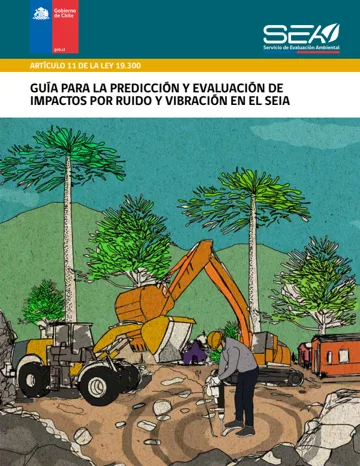
Guide for the prediction and assessment of noise and vibration impacts in the SEIA
- Guidance to describe noise and vibration emissions, predict and assess their impacts and set measures.
- Projects in a DIA or EIA with noise or vibration emissions; assessed under articles 5 to 10 of the SEIA Regulation.
- Model the highest-emission scenarios per period; for D.S. 38/11 sources, prediction to ISO 9613.
Relies on D.S. No. 38/11 (MMA), in force until D.S. No. 14/2024 takes effect.
-
Guide to applying D.S. N°38/11 of the Ministry of the Environment — the noise emission standard for the sources it specifies — to wind farm projects in the SEIA
- Guides how to apply D.S. No. 38/2011 (MMA) in the environmental assessment of wind farms in the SEIA.
- Wind power plants over 3 MW entering the SEIA through a DIA or EIA.
- Check compliance between 6 and 12 m/s; sound power to IEC 61400-11, in third-octave or octave bands.
Relies on D.S. No. 38/11 (MMA), in force until D.S. No. 14/2024 takes effect.
-
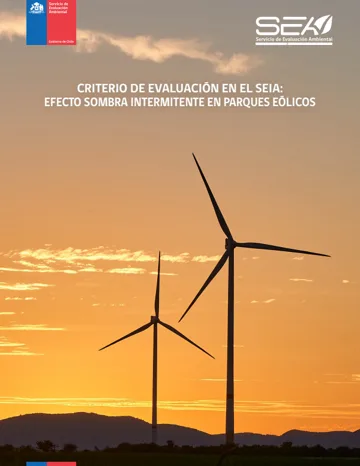
SEIA assessment criterion: shadow flicker in wind farms
- Assessment of wind turbine shadow flicker in a DIA or EIA, as a risk to human health.
- Wind farms in the SEIA; limited to letter a) of article 11 of Law No. 19,300.
- Uses the German guideline: up to 30 h/year and 30 min/day (worst case) and 8 h/year (real).
-
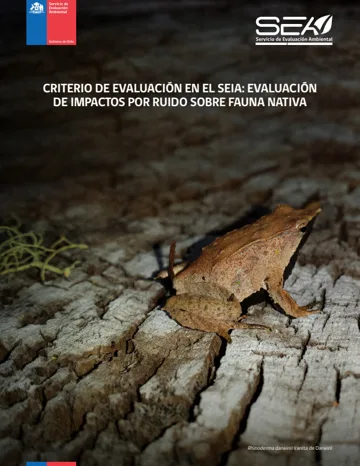
SEIA assessment criterion: assessment of noise impacts on native fauna
- Information project owners must submit to assess noise impacts on native terrestrial fauna in a DIA or EIA.
- Projects whose noise reaches habitats relevant for nesting, breeding or feeding of native fauna.
- Compare project noise with background noise; thresholds per species; without baseline data, assume 25 dB(A).
-
SEIA assessment criterion: assessment of the synergistic effect of noise impacts on human health
- Criteria to assess synergistic noise effects in relation to the risk to human health.
- Projects in a DIA or EIA whose noise areas of influence overlap with projects holding a valid RCA.
- Assess with foreign reference standards: Aragon Law 7/2010 (Ld, Le, Ln) or the FTA manual for transport.
-
SEIA assessment criterion: prediction and assessment of underwater noise impacts
- Information to predict and assess underwater noise impacts on marine fauna in a DIA or EIA.
- Projects with underwater noise sources: dredging, pile driving, drilling, blasting, vessels or engines.
- Characterise each source with SPLrms, SPLpeak or SEL and frequencies; area of influence where it exceeds background noise.
-
SEIA assessment criterion: considerations for predicting and assessing audible noise emissions from the corona effect in power transmission projects
- Guidance to predict and assess audible corona noise on AC and DC lines.
- Power transmission line projects, usually in rural areas with lower baseline noise.
- Empirical formulas per phase; report electric field, conductors, sag and right of way; demonstrate D.S. No. 38/2011 compliance.
Relies on D.S. No. 38/11 (MMA), in force until D.S. No. 14/2024 takes effect.
-
SEIA assessment criterion: scope and methodological principles for the assessment of environmental impacts
- General definitions and criteria to predict and assess impacts and link them to the article 11 effects.
- Applies to EIAs and, where required, to DIAs; aimed at project owners, consultants and assessors.
- Recommends a cause-effect matrix; assesses duration, magnitude and extent; a first approach to polynomials and hierarchical scales.
-
SEIA assessment criterion: methodologies for considering cumulative and synergistic impacts
- General method to integrate cumulative and synergistic impacts into project assessment in the SEIA.
- Considers the interaction of the project under assessment with projects holding a valid RCA (art. 18 of the Regulation).
- Three steps: define the areas of influence, integrate cumulative and synergistic impacts, and assess their significance.
-

SEIA assessment criterion: use of reference standards
- Guidance to select and justify foreign reference standards where there is no national standard.
- Assessment of letters a) and b) of article 11 of Law No. 19,300 in a DIA or EIA.
- Four hierarchical criteria: protection object, regulated activity and source, pollutant and reference threshold.
We work with these criteria every day. If you need to apply them to a project: shadow flicker studies, underwater noise and D.S. N°38/11 compliance assessment.